

From the largest construction sites to uncovering industry flaws with AI
From the Largest Construction Sites to Uncovering Industry Flaws With AI
“On many projects and construction sites, the main oversight tool is prayer,” says Adam Wiśniewski, co-founder of AI Clearing. “It’s a little funny, a little frightening, but that’s how it is,” he adds. That’s why he created a company that aims to change this—and it’s rapidly expanding its presence in the U.S.
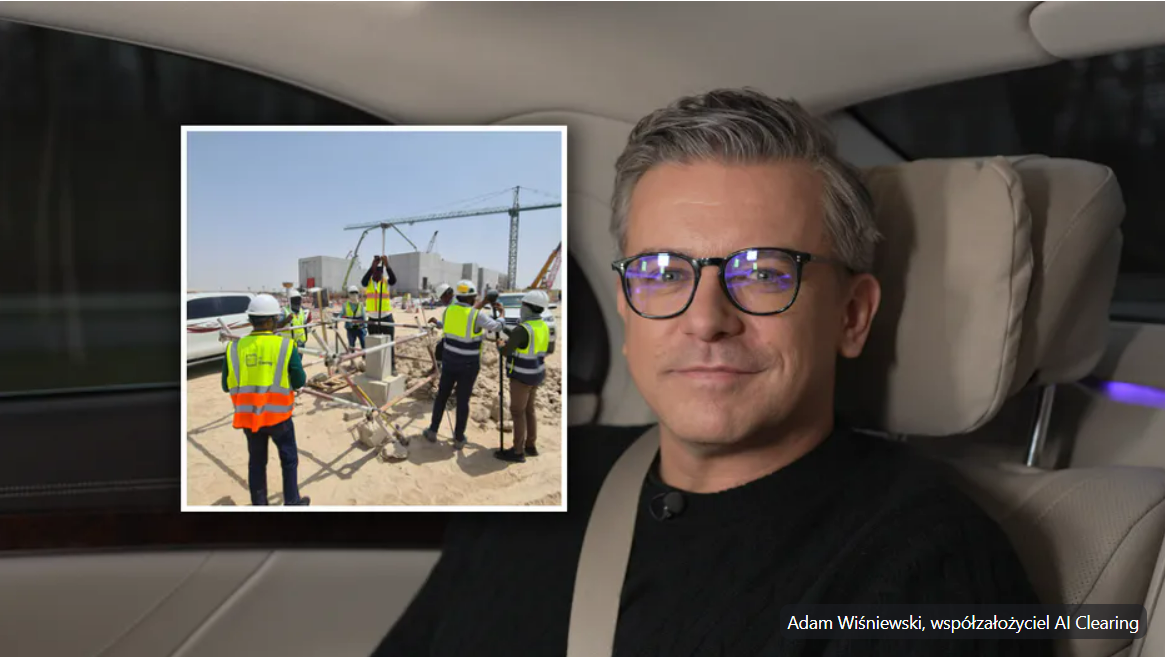
"Biznes Klasa" is a program by money.pl available on YouTube. Its editor-in-chief, Łukasz Kijek, hosts conversations with current and former heads of major companies, as well as people from the business world - discussing their lives, businesses, earnings, and many other topics. The guest of the latest episode was Adam Wiśniewski, co-founder and Chief Technology Officer of AI Clearing, based in Austin, Texas. The company provides automation of oversight processes for large construction projects using artificial intelligence. Since 2021, the company has already invested $14 million (approximately 59 million PLN) in Poland. Over the next few years, it plans to invest $16 million (65 million PLN), with the majority going toward expanding its research and development center.
What really goes wrong on construction sites?
Before founding his company, Adam Wiśniewski spent many years working on construction sites, involved in some of the largest projects in Poland.
"I spent about 10 years on major construction sites… I had a team of 50 engineers working with me. We supervised, for example, the construction of the National Stadium, the Świnoujście Gas Port, and highways such as the A4 and A1," he recalls.
It was there that he noticed how common poor workmanship is - and how it ends up causing the most losses at the end of a project.
"It kind of works like this: everyone hopes it will somehow turn out okay. We close our eyes, pass through this gate, and it’ll be fine. Sometimes it works. But most of the time, it doesn’t. Global statistics show that large projects never stay on schedule or within budget… Everything goes well until all the errors and defects that have accumulated along the way catch up, and in the end, the last 10 percent of construction can take 10 years, just like with the Berlin airport," he says.
A niche on the construction site and a business idea
That’s when he came up with the idea of using drones and a proprietary AI algorithm to catch mistakes at a very early stage.
"Currently, the oversight method - worldwide - is that a surveyor walks around with a measuring rod and checks 3 to 5 percent of the construction site. And they do this once a week, maybe every other day. But a construction site is a pretty dynamic place," he adds.
This is exactly where drones come in.
"From these drones, we can generate really useful data. From flat photos, we create a 3D model. That’s the simplest way to put it. This 3D model is also cartometric, meaning we can measure with centimeter-level precision," he explains.
The 3D model then needs to be integrated with schedules, budgets, and project data, which creates another challenge: the sheer volume of information.
What AI brings and how it detects errors?
The proprietary AI algorithm allows this data to be analyzed instantly and, according to Wiśniewski, that’s what gives his company an edge over the competition.
"Someone flies a drone on Monday at 4 PM, and by 5 AM the next day, we have a complete set of information. (...) The system can detect, for example, that a construction company like ‘Adam & Łukasz,’ a subcontractor for concrete work, poured 5,000 cubic meters, but did so in the wrong location and in the wrong shape. ‘Instead of a rectangle, we made a square because it was easier for us,’” he gives as an example.
In this model, the information arrives before the consequence—before “the prefabricated element arrives for a rectangle, but there’s a square in place.”
Adam Wiśniewski explains that the speed also comes from construction site practices.
"5:30 in the morning is crucial, because most site meetings start at 6 AM, and with this information, the site manager immediately knows what needs to be done," he adds.
How does AI Clearing make money?
"We can take action immediately, instead of waiting for the construction to finish, having to do extra work, go to court, and so on," he explains.
"With our solution, a site manager saves two hours a day… We can reduce the costs we anticipate by up to 4 percent," he calculates.
There’s also the labor market aspect.
"Poland is short of 50,000 workers on construction sites, and I think that’s just the tip of the iceberg," he says. According to Wiśniewski, an AI-based solution like this can help many of the largest companies.
"We build industrial AI. This is not ChatGPT—you or your family will never use our system. But large organizations simply must," he insists.
"We serve 8 out of the 10 largest companies executing energy projects in America," adds Wiśniewski.
The team in Poland has over 120 people, with another 20 in the U.S. The founders of AI Clearing do not disclose their revenue, but they note that last year it was three times higher than in 2023.
Source: www.money.pl
Watch the video on YouTube